The Fourth Rule of The Foundry
Teren Bryson 9 min read [ Ai and llms ] Part 2 of 2
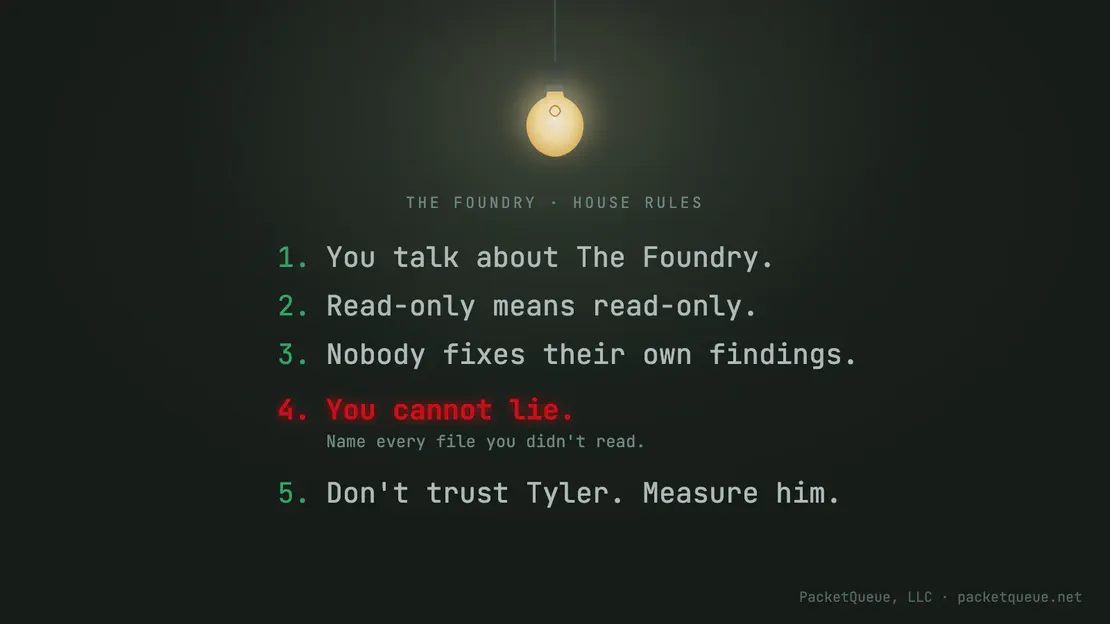
“The Fourth Rule of Project Mayhem is that you cannot lie.” ~ Chuck Palahniuk, Fight Club
In part one I said the first rule of The Foundry is that you talk about The Foundry: the agents I built report what they did, admit what they broke, and leave a paper trail. I still believe that. What I hadn’t thought hard enough about was the gap between reporting what you did and reporting what you didn’t do, and that gap is where my investigator agent had been lurking. Its reports were tidy, confident, and well organized, the kind of onboarding summary I’d have been happy to get from a human engineer, and on a bad day they were missing about a quarter of what was in the code, which is also a lot like a human engineer, just a very junior one. Nobody lied, exactly. It just never mentioned the files it hadn’t opened.
I noticed the missing pieces only because I was reviewing my team’s work, something that I think is critical in agentic development—at least at first. To really make these things work well, you need to have experience in the field. Otherwise, you don’t know what to ask, and you don’t know whether the answers you’re getting are accurate and make sense, or just aggressively wrong.
Those gaps are a big part of why the team has grown since August, so this post is also an update. There are ten agents now instead of nine, plus four skills that my own Claude Code session runs, and the whole thing installs as a Claude Code plugin. Rather than walk through every member in a wall of words, here’s the roster, with what each one does and why I set it up that way:
The Foundry 10 agents, 4 skills
My own Claude Code session is the lead. It briefs every agent, reads what comes back, and owns every commit and push.
Readers
They can't edit anything.
investigate
Sonnet · read-only
Reads a codebase cold before anyone changes it, gives every file its own reader, and ends each report with a list of what nobody read.
Why: Nobody can plan around code they haven't read. Its old habit of skimming is why this post exists.
file-reader
Haiku · Read tool only · new in 2.0
Reads one file, or one slice of a big one, and reports what's in it with line numbers. Only investigate sends it.
Why: With one reader per file, the team found all 48 planted facts in every test run.
architect
Opus · read-only
Turns a request and the investigation into an ordered plan, with file-level scope and a test command for every task.
Why: Trade-offs are where mistakes hide, so planning gets the top-tier model.
uiux
Opus · read-only
Sets the design direction, critiques pages in a browser, and writes the spec before any UI code exists.
Why: Design taste also gets the top tier, and its browser tools only look.
qa
Opus · read-only, runs builds and tests
Hunts for security holes and logic bugs, ranks what it finds, and runs the build and tests to prove it. It never fixes anything.
Why: It caught the cleanup script that wrecked 147 line breaks in part one. A reviewer that can't run things can only squint.
Builders
Each one writes only in its own lane.
implement
Sonnet · application code
Turns a plan task into working code, writing the failing test first for bug fixes.
Why: Working from a good spec doesn't need the expensive model.
frontend
Sonnet · UI code
Builds templates, components, and styles from the uiux spec, then checks the result in a browser, phone widths and dark mode included.
Why: The page gets looked at before anyone calls it done.
test-engineer
Sonnet · tests only
Writes and runs tests, and gets a round at every task in a plan to break what implement just built.
Why: A builder's own tests prove what the builder expected. Somebody else has to try to break it.
devops
Sonnet · config and infrastructure
Handles CI, deploys, migrations, and service config, and treats production as hot.
Why: It checks the state before changing anything, and stops before anything it can't undo.
docs
Sonnet · docs only
Brings CLAUDE.md files, READMEs, and runbooks back in line with reality after changes land.
Why: investigate reads the docs first, so stale docs poison every session after.
Skills
My main session runs these itself, because they have to talk with me, which a subagent can't.
brainstorm
new in 1.2
Talks a new feature through with me in numbered questions, plays the design back in parts, and writes it down.
Why: Nothing gets built until I approve the design.
run-plan
new in 1.2
Runs a plan task by task: build, a round of attempts to break it, at most three fix rounds, and a passing gate before each commit.
Why: It keeps a build log in the plan, so a session that loses its memory halfway picks up where it left off.
debug
new in 1.3
Reproduces a failure, tests one hypothesis at a time, and pins the cause with a failing test before anyone touches the fix.
Why: No fix without a root cause, and three failed fixes stop it to question the design with me.
ship
new in 1.4
Takes finished work through push, PR, CI, merge, and tag, after one ask that lists every step.
Why: I run every production command myself.
Rule four
Reviewing the work told me something was off; a test told me how much, and it’s one I should have run a lot sooner. I built a 191-file practice repository, planted 48 specific facts in it (things a good investigator ought to find and report) along with a few decoys, and ran the old investigator against it three times. It found 35 facts, then 35 again, then all 48. It made nothing up in any run, which already puts it ahead of plenty of status reports I’ve read. The third run proved it could find everything, so the problem was diligence: handed a big pile of files and told to read them all, it skimmed. This is a known issue with LLMs, and something I write about in my Prompting Claude series.
The fix was to stop asking one agent to read everything. In version 2.0, investigate hands off every file to its own file-reader, ten at a time, and splits anything over about 1,000 lines into overlapping sections. File-reader holds the Read tool and nothing else, so it can’t edit anything, wander off, or start agents of its own; it reads its one file and reports what’s in it, with line numbers. Investigate then checks the readers’ results against its own list of files, sends a reader for every gap, and ends its report with a Coverage section that names every file nobody read. On a repository over 500 files, it stops and asks me before it starts. Against the same practice repo, three runs, the new version found all 48 facts every time and made up none.
What it costs
Now the part that doesn’t help my case. The old investigator cost about 47 cents a run on that test, and the new one costs about $2.31, roughly five times as much. With every agent on Sonnet, the mid-tier model, it ran about $5.57. Moving everything to Haiku, the cheapest model, was cheaper still, but one run lost its entire report, and every run was slower, so the readers run on Haiku and investigate stays on Sonnet. I made that call, and I’d make it again: five times the price of a skimmed report is still cheap next to a plan built on files nobody opened. Your math may differ, especially on a big repository, since the bill grows with the number of files.
There’s one more wrinkle, and it’s my favorite. The test harness’s first verdict said the new version failed, because the scorer counted decoys as made-up facts even when a report had marked them dead. I fixed the scorer, rescored every stored report, and the new version passed. Then the Haiku version failed the same way, on decoys a report had marked dead under a bold label, and I fixed the scorer a second time. So I’ve now lived the robots-grading-robots problem, and the robot that needed the most correcting was the one doing the grading. Quis custodiet ipsos custodes, Juvenal asked; he was talking about guards and wives, not test harnesses, but the question works here, and sometimes I just need an excuse to trot out random literature quotes.
How I actually use it
I use the team for just about everything code-based that I do now: investigating older codebases of mine, finding software errors (again, mostly in my old code), and building new software, with me as the director and the team doing the work. I’m still in the review-it-myself stage, to a certain extent, but my confidence is growing with each task.
The shape is simple even when the work isn’t. My main Claude Code session leads and usually runs a more capable model (Opus or Fable): it briefs each agent on what it needs, reads what comes back, and owns every commit and push. A new feature starts with brainstorm, which asks me numbered questions and builds nothing until I approve the design. The architect turns that design into a plan, run-plan builds it task by task with test-engineer trying to break each one, and ship walks the result out the door, asking once with every step listed. I run every production command myself, and ship is written so that it never runs one. It’s slower than asking one model to just do the thing, and I won’t pretend otherwise; for a small, fully specified change, the pipeline steps aside and the work just gets done.
The fifth rule
Part one’s rule still holds, since a team that reports what it did is worth more than one that doesn’t. A report is only as good as what it leaves out, though, and I didn’t know what mine left out until I measured it. The Foundry is still free, still MIT licensed, and still at github.com/SomeClown/the-foundry . If you install it, try it on something you know cold before you hand it something you don’t, because Palahniuk’s narrator found out the hard way where the next rule leads:
“The Fifth Rule of Project Mayhem is you have to trust Tyler.” ~ Chuck Palahniuk, Fight Club
I’d rather measure Tyler. So far he’s earning his keep, at about five times the old rate.
Related Posts
The First Rule of The Foundry
I built a nine-member AI development team while cleaning up my blog repo, mostly by trial and error, and I'm releasing it, free, on GitHub.
[ Ai and llms ] Part 2 of 6 3 min read
Prompting ClaudeIt Copies Everything
I'd like to claim I've never taught a model a bad habit by accident. A model learns from every part of an example, including the parts you didn't mean to teach, so here's how to pick them, on one chart. Part two of six.
[ Ai and llms ] Introduction 3 min read
Prompting ClaudeMost of What You Know About Prompting Is From 2023
Prompting advice ages faster than the models it was written for, and a lot of what's still online, including my own notes, now backfires. An introduction to a six-part series where the infographics do the heavy lifting.