Submarines, Swimming, and Confident Wrong Answers: What LLMs Are Good (and Bad) At
Teren Bryson 11 min read [ Ai and llms ] [ Security ] Part 6 of 8
“…a question of which we now know that it is about as relevant as the question of whether Submarines Can Swim.” — Edsger Dijkstra, on Alan Turing’s question of whether machines can think, in “The threats to computing science” (EWD898, 1984)
Dijkstra dropped this quote during a keynote in Austin in November 1984, about a question that was already more than thirty years old and that people were, even then, tired of arguing about. A submarine moves through water under its own power, quickly and usefully, and whether you want to call that swimming is a matter of vocabulary, not engineering. The same goes for the argument over whether a language model “really” understands anything. It’s an old and boring fight; it has produced far more arguments than answers, and it tends to distract from the more useful question: namely, what do these things reliably do, and what do they look like when they fall on their collective asses?
I wrapped up part five with Cecily’s reply to Miss Prism, that the diary “usually chronicles the things that have never happened,” and promised to explain why that happens and what these models are good at despite that. This is where the previous five posts have been heading. You now know the model is a stack of matrices (part one ), trained to guess the next token (part two ) on gigantic clusters (part three ), served under tight memory limits (part four ), and handed its entire conversation on every turn (part five). This post uses that machinery to explain both the strengths and the failures, because I think the second follows directly from the first. By way of warning, this is almost assuredly the most contested topic in the series, and no quick summary will satisfy everyone, so take what follows as my wild-eyed ramblings on the topic, along with my reading of the evidence and the weak spots noted as we go.
What it’s good at
If the core operation is producing a somewhat plausible continuation of text, then tasks shaped like continuing or transforming text should go well, and in my experience they do. Summarizing long documents and contracts, rewriting something for a different audience, translating, explaining what a block of code does, triaging emails and a calendar, drafting boilerplate, and turning notes into a somewhat passable first draft all go well most of the time. These are observations, not measurements, and I’m deliberately not citing a benchmark to back them up. Benchmarks in this field age about as well as milk, and they’re a favorite target for optimization, which is a nice way of saying that models get trained to score well on them.
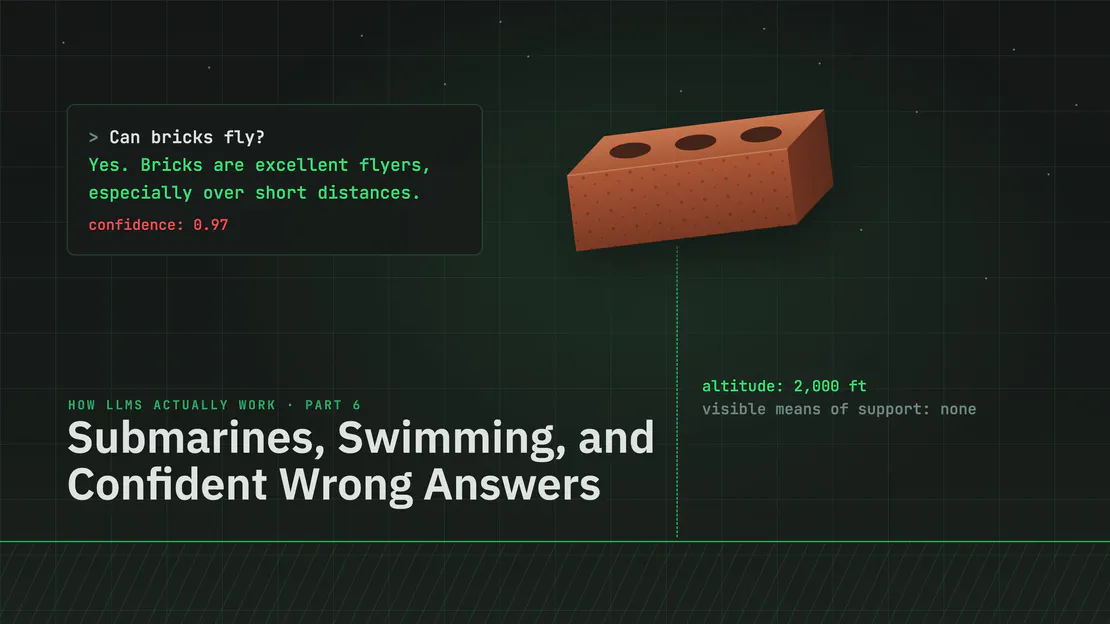
Some of this is still a little hard to believe, even after five posts explaining how it works. Nothing about a stack of matrices trained to guess the next token obviously ought to produce a correct explanation of somebody else’s regular expression, and yet it frequently does. Douglas Adams, describing the Vogon fleet arriving over Earth in The Hitchhiker’s Guide to the Galaxy, wrote that “the ships hung in the sky in much the same way that bricks don’t,” and that’s about the best description I have of language models on a good day. It doesn’t obviously follow from the mechanism, yet there it is anyway, hanging about in the sky. It’s also Dijkstra’s submarine again: easier to say what the thing doesn’t do than to find the right words for what it does.
The strengths are real for the same reason the weaknesses are. A system that has absorbed trillions of tokens of human writing has an enormous number of patterns to draw on, and it can combine them in ways that look inventive, almost human-like, and frequently are. What it doesn’t have is an inherent separate process whose job is to check whether the result is true. In kitchen terms, it’s a line cook who has never once said “eighty-six.” Run out of the halibut, and you’ll still get a beautifully presented plate with something on it that looks a lot like halibut. Language models also tend to tell us what we want to hear; researchers call it sycophancy, and a 2023 study found it consistently in all five AI assistants it tested, likely driven in part by people rating agreeable answers more highly.
Hallucination: the exam with no penalty for guessing
Picture a multiple-choice exam where a blank answer scores zero and a wrong answer also scores zero. Nobody leaves a question blank on that exam; guessing is the rational move every time. Now imagine the student has read most of the internet (my misspent youth) and can produce a fluent, plausible answer to anything you ask. That’s roughly the argument in Why Language Models Hallucinate , a September 2025 paper by Adam Tauman Kalai, Ofir Nachum, Santosh Vempala, and Edwin Zhang, which opens on that same picture of a student guessing on a hard exam. The authors argue that models make up plausible but completely incorrect answers because “the training and evaluation procedures reward guessing over acknowledging uncertainty,” and that the benchmarks everyone uses to rank models penalize a model for saying it isn’t sure. A bit like some humans, actually. Their proposed fix isn’t another hallucination test. It’s changing how the existing, leaderboard-dominating benchmarks are scored, so that “I don’t know” stops counting the same as a wrong answer.
That lines up with the mechanism from part one. At every step, the model produces a probability for every possible next token and then picks one. There’s no built-in “I don’t know” switch; “I don’t know” is just another string of tokens, and the model has to be rewarded for producing it at the right moments. If the training signal never rewarded it, what you get instead is fluent invention, delivered with exactly the same confidence as everything else. That’s when you find out which of the ships were bricks all along.
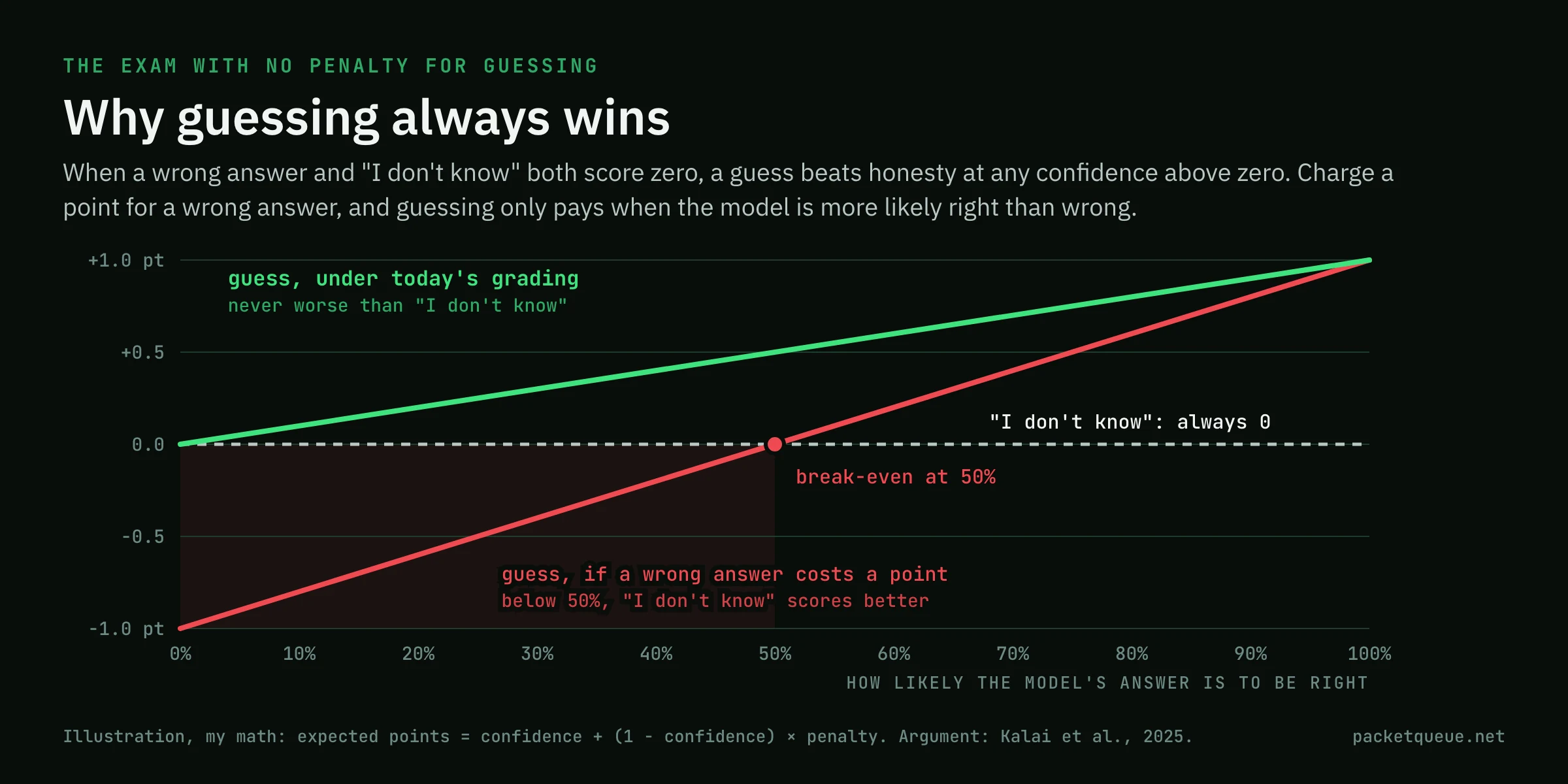
I will admit that this is one explanation from one group of researchers, and hallucination rates vary tremendously by task, by model, and by how you ask. I haven’t found a 2026 measurement I’d stand behind, and I’d be suspicious of anyone who quotes a single number for it.
Reasoning that comes apart
The newer “reasoning” models spend extra tokens working through a problem before they answer, and on many tasks they do measurably better. They also fail in ways that can be harder to predict. In June 2025, a team of researchers at Apple published The Illusion of Thinking , which tested reasoning models on puzzles, like the Tower of Hanoi, whose difficulty they could dial up one step at a time. They reported that the models “face a complete accuracy collapse beyond certain complexities,” and, stranger still, that the models’ reasoning effort rose with difficulty up to a point and then fell off, even though they had token budget to spare. In other words, past a certain point, the harder the puzzle got, the less it tried.
I wouldn’t die on that hill just yet, however. Within days, a published comment by A. Lawsen argued that the collapse mostly reflected the experiment’s design rather than any failure of reasoning: some of the Tower of Hanoi answers would have run past the models’ output limits, and some of the river-crossing puzzles had no solution at all for larger sizes, so the models were marked wrong for not solving the unsolvable. Where the truth lands between the two papers, I can’t tell you, and I’m not sure anyone can yet; I’d take both as reasons to test the specific task you care about rather than trust either headline, though that’s just good practice for most things.
Two other limits come straight from earlier posts. Models can lose track of material buried in the middle of a long prompt, which we covered in part five, and because the output is sampled rather than computed one fixed way, asking the same question twice can get you two different answers. Anyone who has ever asked two senior engineers the same design question will find the second one oddly familiar, though I always tended to give the somewhat waffling answer everyone loves: “it depends.”
When the model has hands
Everything so far assumes a person reads the output before anything happens. The industry’s current push is agents, where the model can call tools, run code, browse the web, and take actions on its own. That changes the stakes considerably, because a language model doesn’t reliably distinguish between instructions from the person using it and instructions hidden in text it happens to read along the way. The second kind is called prompt injection, which is not always malicious, and it’s one of the oldest unsolved problems in this space.
A disclosure published in October shows what it looks like. Researchers at Zenity Labs reported that a single prompt sent to a public-facing agent on one major cloud provider’s managed agent service could get the agent, which had a web-request or shell tool, to query the local metadata endpoint at 169.254.169.254 and hand back the temporary credentials for its execution role. If that address looks familiar, it should; it’s the link-local metadata address that network and cloud people have been fencing off for years. According to the researchers, the default role was broad enough to reach every other agent in the same account and region, along with their chats, long-term memories, API keys, and stored secrets. No bug in the chat interface was needed; the agent just did what it was asked. Security, however, is mostly a topic for another day.
The provider disputes that any of this is a vulnerability, saying that an agent’s access to its own role’s credentials through the metadata service is expected and documented behavior. The researchers, for their part, report that the provider moved to a stricter version of the metadata service and removed the broadest default permissions after they reported it. I think both can be true at once: documented behavior can still be a dangerous default, and documentation has never stopped an attacker who didn’t read it.
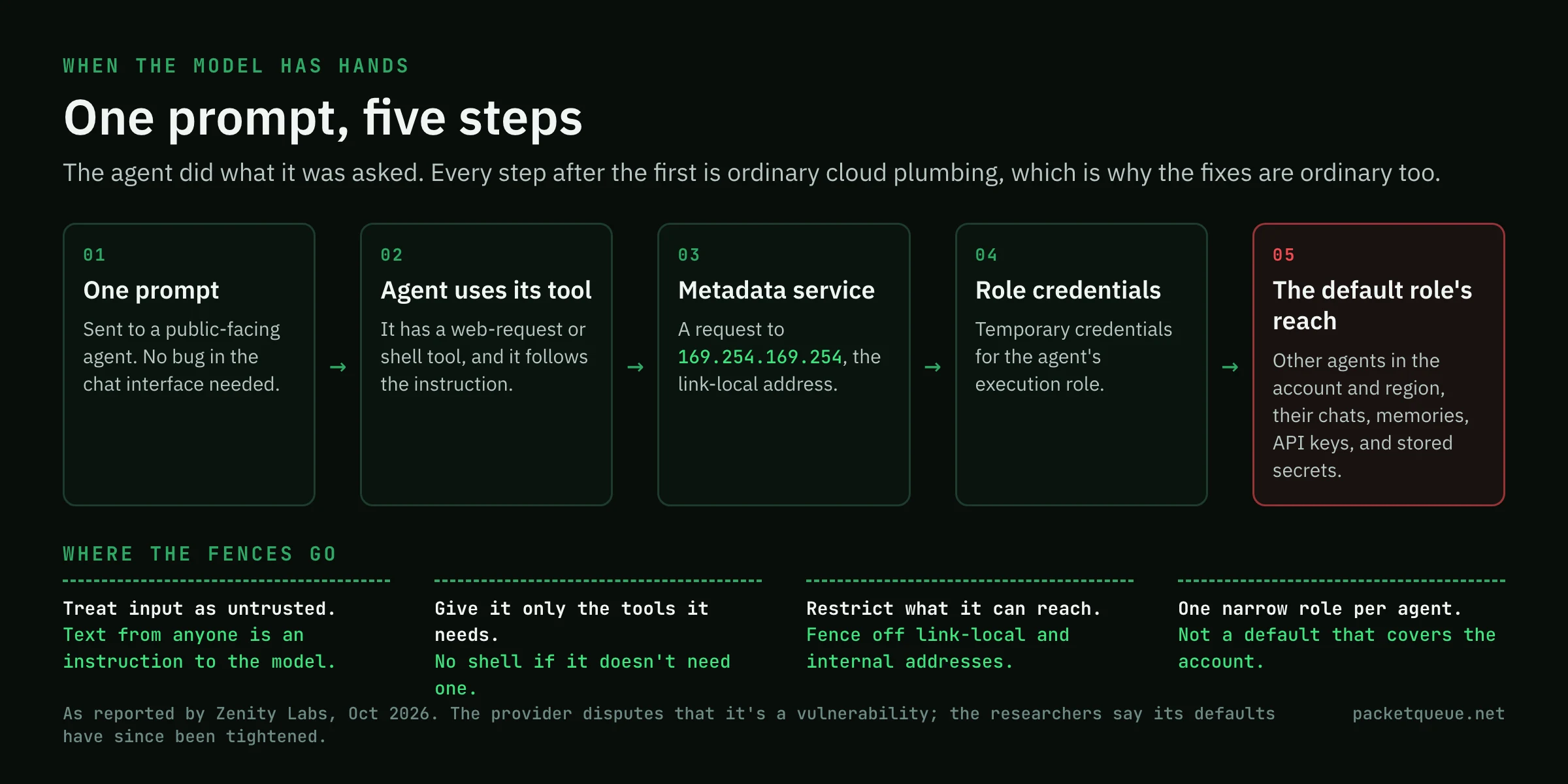
None of the lessons here are particularly exotic or novel. They’re the ones network and security people have been teaching for decades: give each component the narrowest permissions it needs to do its job, restrict what it can reach on the network, and don’t let untrusted input anywhere near something that can act on it. The model is a component that follows instructions written in plain text, from anyone. Design the system on that assumption, and you’ve done most of the work; design it on the assumption that the model knows who its boss is, and you’ll eventually be writing an incident report.
Using them sensibly
None of this adds up to “don’t use them.” It adds up to knowing what the failures look like and building around them. Check any claim that matters against a primary source, and ask the model to show you its sources so you can check those, too, because it will occasionally invent one of those as well. Put the important material at the start or end of a long prompt. Give an agent scoped credentials, never your own keys; use a key vault where possible. Keep a person in the loop for anything consequential or irreversible. Those are the same instructions I’d give a bright, fast, overconfident junior engineer, and I’d expect roughly the same mix of very good work and confident mistakes.
One last concession, about vocabulary. “Hallucination” is a metaphor borrowed from perception, and it can mislead, since the model isn’t seeing something that isn’t there; it’s generating a plausible continuation that happens to be false. If you prefer “confabulation” (as I tend to) or just “error,” I won’t argue, which, given this post’s opening, would be a little hypocritical anyway.
Answers, and the questions
Which brings me back to Dijkstra, via a remark from Pablo Picasso. In William Fifield’s composite interview with Picasso for The Paris Review in 1964, Picasso says of the new calculating machines: “But they are useless. They can only give you answers.” The version that gets passed around, “Computers are useless,” is a later paraphrase, and the quotation site I used lists the whole thing as attributed rather than confirmed. It doesn’t read as a compliment.
I’d take it as a job description. These systems are good at answers, and the supply of answers is now effectively unlimited. What they don’t supply is the question: deciding what’s worth asking, noticing when an answer is a little too smooth, and knowing what you’d actually do with it. That is why I always argue that you need expertise in what you’re asking of an LLM before you can understand the quality of what you’re getting back. Whether a submarine swims is a matter of taste. Whether you should trust where it takes you is not.
That’s the series, mostly. Two bonus parts are still to come: an explainer on RAG, and a glossary of every term I’ve thrown at you along the way. Everything so far, plus the introduction, is linked from the series map , and if I’ve gotten something wrong across this many posts of this scope (and I almost certainly have), I’d genuinely like to hear about it.
Related Posts
[ Ai and llms ] Part 4 of 6 4 min read
Prompting ClaudeStable Stuff First, Question Last
Buy the ticket, take the ride. The prompt layout that helps a model remember the middle also decides what every call costs: prompt caching, the timestamp mistake, and the math, on one chart. Part four of six.
[ Ai and llms ] Part 5 of 8 10 min read
How LLMs Actually WorkA Diary It Rereads Every Time: Context Windows and LLM "Memory"
A language model has no memory in the sense you'd expect. Nearly everything that looks like memory is text being resent, summarized, searched, or stored by the software around it, and the diary gets heavy fast. Part five of eight.
[ Ai and llms ] Part 3 of 6 3 min read
Prompting ClaudeMake It Show Its Work First
Ever been to a really long meeting? A model forgets the middle of a long prompt the same way. The fix is a layout: documents on top, quotes first, the question last, all on one chart. Part three of six.