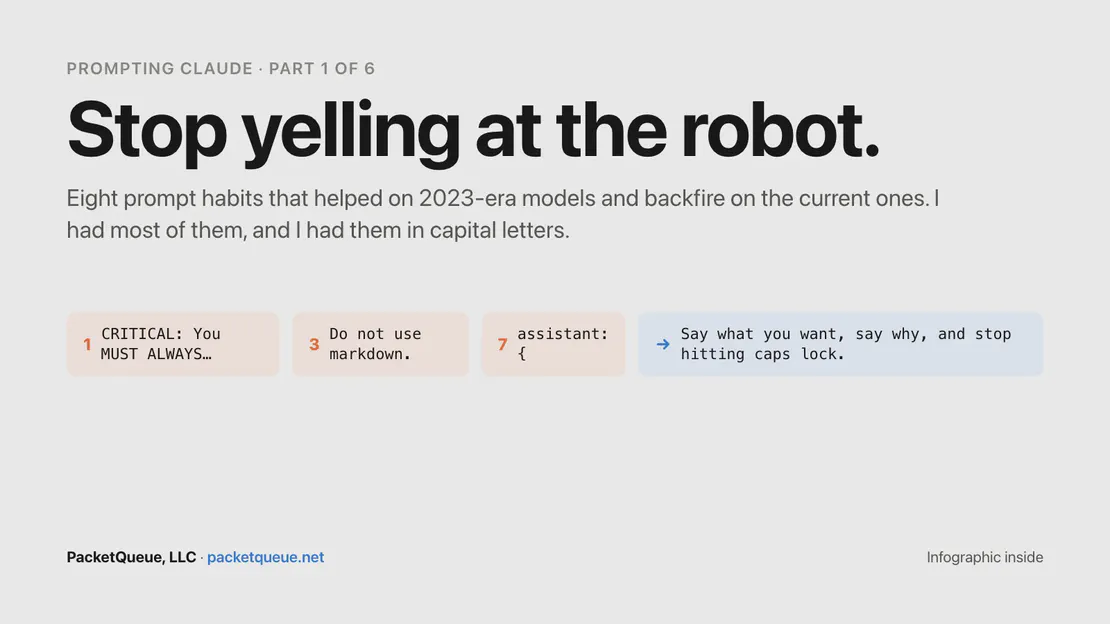
Stop Yelling at the Robot
Teren Bryson 2 min read [ Ai and llms ] Part 1 of 6
I used to write prompts the way I wrote change-window emails to the NOC: in capital letters, with the word CRITICAL in them. It worked about as well on the model as it did on the NOC.
The difference is that the models got better at listening. Shout at a current one and it overreacts to whatever you shouted about, which Anthropic’s own docs now call overtriggering and tell you to tone down. Most of what I knew about prompting in 2023 has aged the same way. The chart below is eight of those habits, what each one does now, and what to do instead.
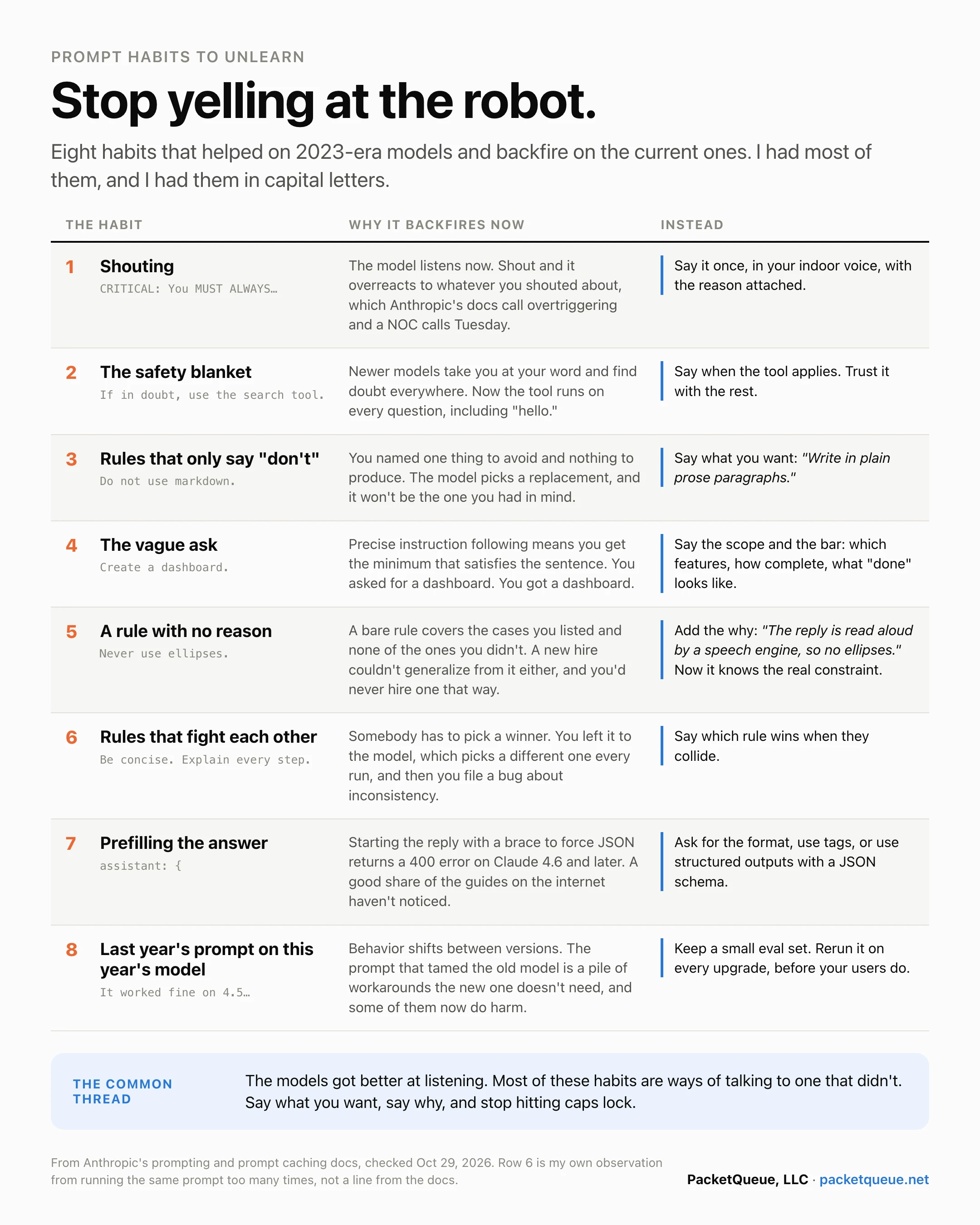
Three of them cost me the most. “If in doubt, use the search tool” sounds harmless until a model that takes you at your word finds doubt in every question, including hello. “Do not use markdown” names one thing to avoid and nothing to produce, so you get whatever it picks as the replacement. And prefilling the reply with a brace to force JSON, which a good share of the guides online still recommend, returns a 400 error on Claude 4.6 and later. The guides haven’t noticed.
In fairness, most of the chart comes straight from Anthropic’s docs, but one row is mine: contradictory rules, where “be concise” and “explain every step” fight it out and the model picks a different winner every run. That’s a thing I’ve watched happen, not a thing I’ve measured. And if you’re still pinned to an older model, some of these habits are still harmless there. Check before you unlearn.
The common thread is the one habit under all eight: say what you want, say why, and stop hitting caps lock. The models were never the problem with my change-window emails either.
What’s the worst thing you’ve put in capital letters in a prompt? Mine’s on the chart.
Related Posts
[ Ai and llms ] Introduction 3 min read
Prompting ClaudeMost of What You Know About Prompting Is From 2023
Prompting advice ages faster than the models it was written for, and a lot of what's still online, including my own notes, now backfires. An introduction to a six-part series where the infographics do the heavy lifting.
[ Ai and llms ] Part 2 of 6 9 min read
How LLMs Actually WorkFail Better, Fifteen Trillion Times: How an LLM Is Trained
Training turns roughly 405 billion random numbers into something useful through one boring move: guess the next token, get graded, nudge every number a hair, and repeat. Part two of six.
[ Ai and llms ] Part 1 of 6 11 min read
How LLMs Actually WorkJust a Lot of Multiplication: What's Actually Inside an LLM
A large language model is an enormous pile of numbers, and everything it does comes from multiplying other numbers by that pile. Part one of six.