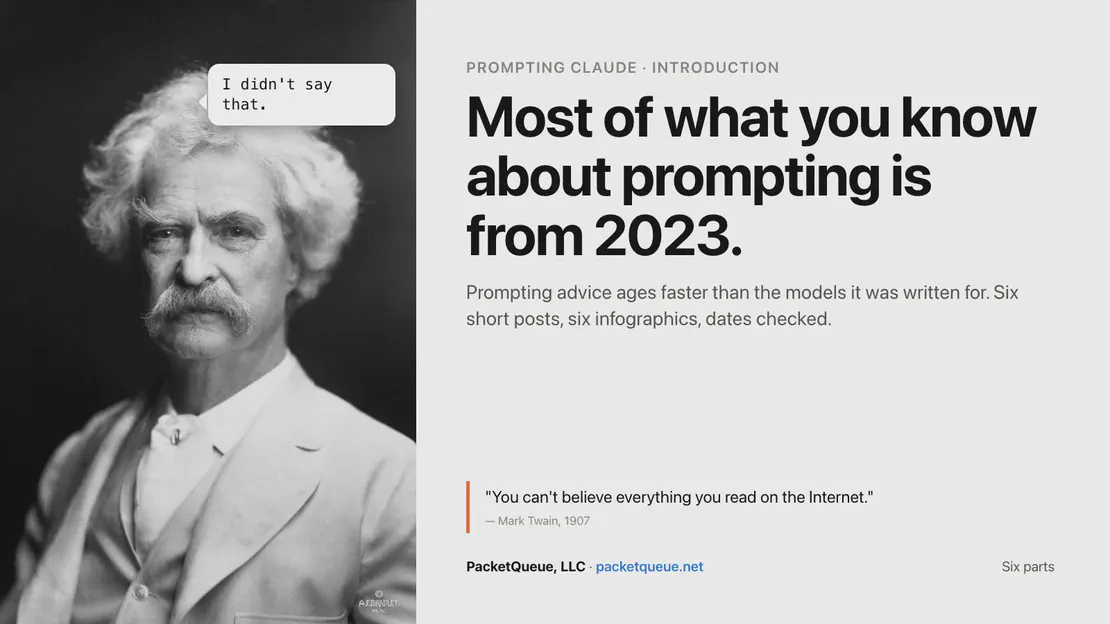
Most of What You Know About Prompting Is From 2023
Teren Bryson 3 min read [ Ai and llms ] Introduction
“It ain’t what you don’t know that gets you into trouble. It’s what you know for sure that just ain’t so.” — attributed to Mark Twain
I couldn’t find that line in anything Twain wrote, which puts it in good company with a large share of the Twain quotes on the internet. It’s staying in anyway, with the caveat attached, because it’s the best one-sentence summary of prompting advice in 2026 I’ve come across. The trouble isn’t what people don’t know about talking to a language model. It’s the things they know for sure, from a guide somebody wrote in 2023 and never took down.
I should know. I was a reliable source of that advice. I wrote prompts the way I wrote change-window emails to the NOC, in capital letters with the word CRITICAL in them, and I handed the model seven-step reasoning plans the way I’d hand a runbook to a new tech. Then the models got better at listening, and those habits started backfiring. Shout at a current model, and it overreacts to whatever you shouted about. Start its reply with a prompt to force JSON, a trick half the tutorials online still teach, and Claude 4.6 and later returns an error instead of JSON. Copy last year’s prompt onto this year’s model, and you’ve shipped a pile of workarounds the new model doesn’t need, some of which now do harm.
None of this is secret. Anthropic’s own docs say most of it pretty clearly, and those docs are where I checked every claim in this series, on dates I’ll try to remember to name in each post. That’s also the weak spot, and I’ll own it up front: it’s the vendor describing its own product, the series is about Claude specifically, and the numbers will drift. Keep a small set of test prompts and rerun it on every model upgrade, which is advice I give with the confidence of someone who learned it the expensive (read: lots of tokens burned) way.
Here’s the plan. Six short posts, one a week, maybe more frequently, and in each one an infographic does the heavy lifting while the post tells you why it matters and what it cost me to find out:
- Stop yelling at the robot: eight habits that helped on 2023-era models and backfire on current ones. Already up.
- It copies everything: how few-shot examples teach the model things you didn’t mean to teach, and how to pick them.
- Make it show its work first: long documents, the lost-in-the-middle problem, and the quote-first trick that fixes it.
- Stable stuff first, question last: the one prompt layout that fixes recall and the bill at the same time.
- It’s smarter than your checklist: adaptive thinking, and why your step-by-step plan is the ceiling.
- Make it show you the middle: when to split a job into separate calls, and when you’re just adding calls.
Each infographic stands on its own, so if you’d rather skip my prose and take the chart, I won’t be offended. Much. Probably.
The point of the whole exercise is to replace what I knew for sure with what the docs say this month, and to try to keep us all ahead of the curve on this. That won’t keep it true forever. I hope, however, it will keep it from being the kind of thing that just ain’t so.
Related Posts
[ Ai and llms ] Part 1 of 6 2 min read
Prompting ClaudeStop Yelling at the Robot
I used to write prompts the way I wrote change-window emails to the NOC: in capital letters, with the word CRITICAL in them. Eight prompt habits that helped on 2023-era models and backfire on the current ones, on one chart. Part one of six.
[ Ai and llms ] Part 2 of 6 9 min read
How LLMs Actually WorkFail Better, Fifteen Trillion Times: How an LLM Is Trained
Training turns roughly 405 billion random numbers into something useful through one boring move: guess the next token, get graded, nudge every number a hair, and repeat. Part two of six.
[ Ai and llms ] Part 1 of 6 11 min read
How LLMs Actually WorkJust a Lot of Multiplication: What's Actually Inside an LLM
A large language model is an enormous pile of numbers, and everything it does comes from multiplying other numbers by that pile. Part one of six.