It's Smarter Than Your Checklist
Teren Bryson 4 min read [ Ai and llms ] Part 5 of 6
“No soup for you!” ~ The Soup Nazi, Seinfeld
If you watched Seinfeld in the nineties, you remember the soup stand: one exact way to order, no chatter, no complaints, and anyone who broke the procedure got their money back and no soup. For a few years, we tended to write prompts the same way. We handed the model a numbered procedure for how to think (restate the question, list the facts, weigh each one, rank the options, explain your reasoning) and expected it to follow along, step by step, without deviating. I wrote more of those than I’d like to admit, though to be fair, on the models we had back then, spelling out the steps did seem to help.
It doesn’t help much anymore, however, and it is likely holding the model back. Anthropic’s prompting docs now say that a general instruction like “think thoroughly” often produces better reasoning than a hand-written plan, because “Claude’s reasoning frequently exceeds what a human would prescribe.” That’s the vendor talking about its own model, so take it as a claim to test rather than a fact, as always, but it matches what I’ve seen: the seven-step plan keeps the model inside the limits of what I thought of, and the restate-the-question and explain-your-reasoning steps mostly add output, which you pay for.
What changed is that the model now does its own “thinking” before it answers. Anthropic calls it adaptive thinking : on each request, the model decides whether to think and how much, so a simple question might get a direct answer while a hard one gets deeper reasoning. This is also heavily influenced by the effort level setting on each model, as well as model selection. On the newest models, it’s on by default, and on Opus 5.5 and the Fable models it’s always on. The old way of controlling it, a fixed budget of thinking tokens, returns an error on Claude 4.7 and later. Ask Opus 5.5 to turn its thinking off, and you get a 400 error, which is about as close as an API gets to no soup for you.
As mentioned above, the control you get instead is effort, a dial with five settings from low to max. Higher effort means the model thinks more readily and for longer; lower effort means it skips thinking on easy requests and thinks less on the rest. Most models default to high, and Opus 5.5 and Haiku 5.5 default to medium. The thinking itself is billed as output tokens, so effort also determines what a request costs.
So what goes in the prompt, if not the steps? The chart below has the version I’d use now: tell it to think thoroughly, say what a finished answer looks like, and add one line asking it to check its own work before it finishes. The docs say that last line “catches errors reliably,” with one exception: Opus 5 already checks itself, so asking it is, in this case, redundant and will make it check twice.
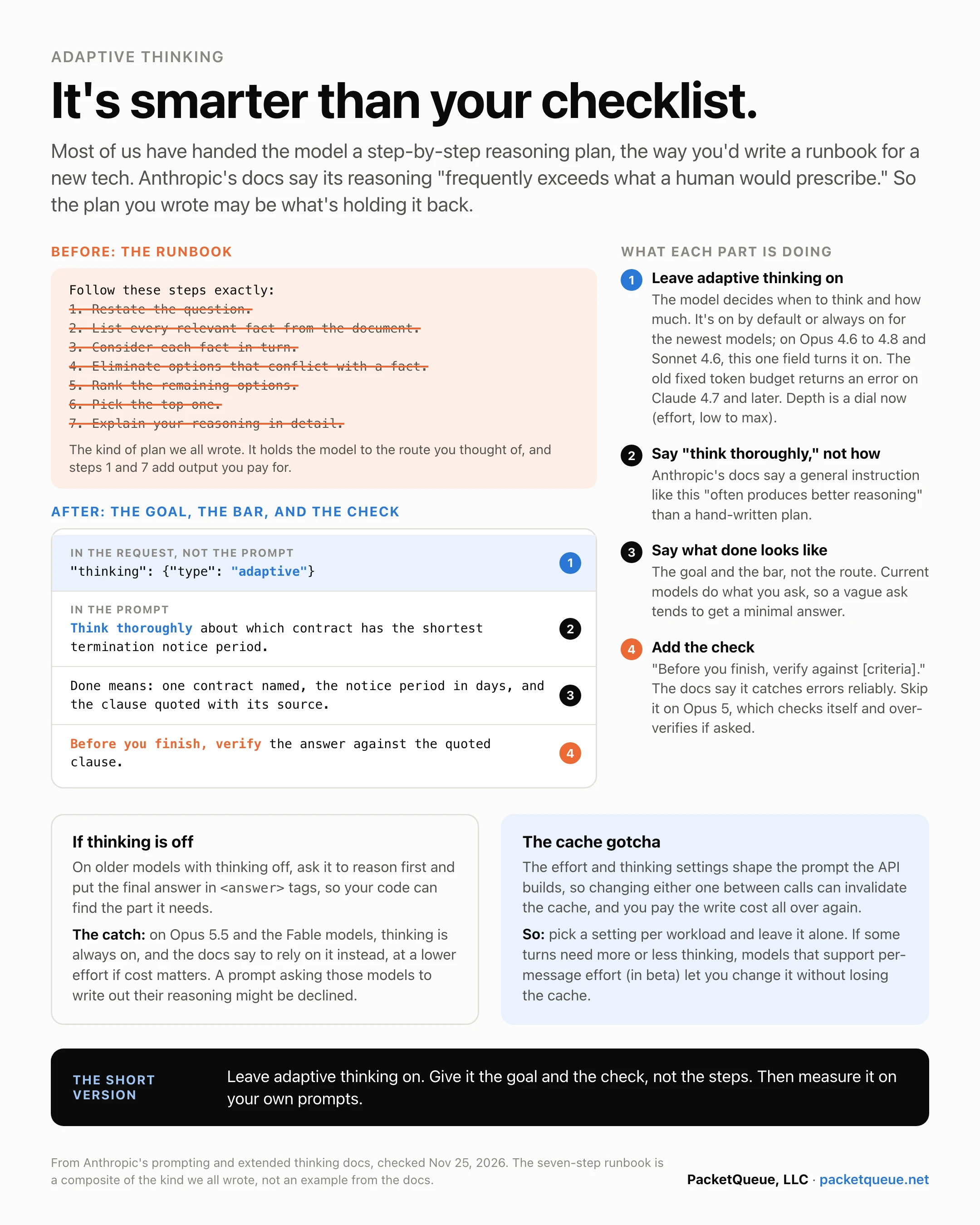
Before we all run out and proverbially toss every old prompt: keep in mind that, on older models, with thinking off, asking the model to reason first and put its final answer in tags still works. The newest models are the opposite case. The docs say to rely on their built-in thinking instead, at a lower effort setting if cost matters, and that a prompt asking them to write out their reasoning might be declined. The same prompt can work for one model and not for the next, which is the best argument I know for keeping a few test prompts around and rerunning them on every upgrade.
One more thing ties back to last week’s post . The effort setting shapes the prompt the API builds from your request, so changing it between calls can invalidate the cache, and you pay to write it all over again. Pick a setting for each kind of work and leave it alone. Some models now let you change effort per message without losing the cache, but that’s still in beta as of this writing.
So, close the soup stand. Just tell the model what you want and how you’ll check it, and let it work out the path to take to get there. It’s almost assuredly smarter than your checklist, and if you try to take its thinking away on Opus 5.5 at least, the API already has its answer ready to go.
A disclosure, now that Anthropic is a public company: I don’t own any of its stock directly. My 401(k) and IRA are in funds that may buy it along with plenty of other companies, and those funds have never once asked my opinion before buying anything. If this post moves the share price, I’ll be as surprised as you are.
Related Posts
[ Ai and llms ] Part 4 of 6 4 min read
Prompting ClaudeStable Stuff First, Question Last
Buy the ticket, take the ride. The prompt layout that helps a model remember the middle also decides what every call costs: prompt caching, the timestamp mistake, and the math, on one chart. Part four of six.
[ Ai and llms ] Part 3 of 6 3 min read
Prompting ClaudeMake It Show Its Work First
Ever been to a really long meeting? A model forgets the middle of a long prompt the same way. The fix is a layout: documents on top, quotes first, the question last, all on one chart. Part three of six.
[ Ai and llms ] Part 2 of 6 3 min read
Prompting ClaudeIt Copies Everything
I'd like to claim I've never taught a model a bad habit by accident. A model learns from every part of an example, including the parts you didn't mean to teach, so here's how to pick them, on one chart. Part two of six.